










Intermodal terminal Jerez de la Frontera
Access
The terminal is located in a strategic point, in the industrial area of the city of Jerez transport, with access to less than 600 mts. the Autovía del SUR (A-4), one of the six radial highways in Spain that links the cities of Madrid, Cordoba, Seville and Cadiz, among others.
This connectivity is an additional attraction to those already provided by this new railway point.
Facilities providing railway services
Location:
Ciudad del Transporte, Jerez de la Frontera (Cádiz).
Situated 4 km north of the town of Jerez de la Frontera, in the district of Guadalcacín.
Access by road via the N-IV from the west and the AP-4 from the east.
Rail access is at kilometre marker 98.484 on the Seville–Cádiz railway line.
Facilities:
Multi-purpose (intermodal rail-road). Intended for the loading and unloading of goods transported by rail (considered the main activity). Other activities are also envisaged, such as storage, warehousing, workshops for auxiliary equipment, etc.
The handling of dangerous goods is not permitted.
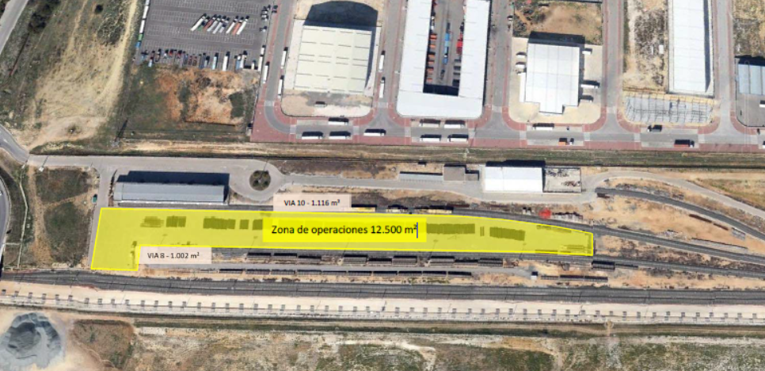
The site covers an area of 12,500 square metres.
The 12,500 m² operations area consists entirely of cobbled surfacing.
An area of 1,002 m², for the exclusive use of track No. 8, which has a total length of 555 metres to the track end. Its usable length (track length with access to the loading bay) is 334 metres.
An area of 1,116 m², for the exclusive use of track 10, which has a total length of 595 metres to the marker and a usable length of 372 metres.
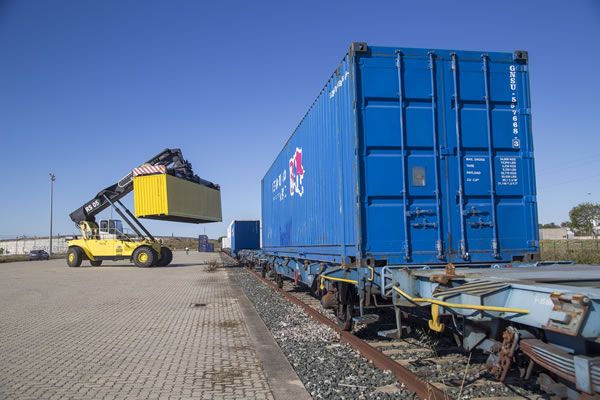
The main activities to be carried out on this site will be those associated with the loading and unloading of trains and the storage of containers.
Machinery
For the realization of the different operations, it is available:
- 2 REACH STACKER
- 2 FORKLIFT TRUCKS
TOS POSEIDON
The terminal incorporates POSEIDON rail services specific management software, which allows the transfer of information in EDI format and complies with the industry standard.
POSEIDON provides flexibility, speed, efficiency and cost reduction associated with terminal management.
Servicios associated with the terminal
- Development of a new cargo management area in a warehouse of 1,200 square meters, with piers of load and possibility of managing refrigerated loads.
- Depot for empty containers.
- Repair of containers.
- Groupage.
- Consolidation and deconsolidation of loads.
- Zone of exchange of goods on trailers.
Opening hours:
Available 24 hours a day, 7 days a week.
Minimum notice period required to process the customer’s request: the service must be requested at least 6 hours in advance.
railway station charges

Key contact details for the operator of the service facility.
COMPAÑÍA GADITANA DE CONTENEDORES, S.L.
AVENIDA DEL PUERTO No. 1, 6th Floor, Flat B. EDIFICIO TROCADERO
11006, CÁDIZ
TEL 956 552748/65 and 956 552749
Option to provide railway services in-house and the conditions applicable in this regard
As set out in the SPECIAL TERMS AND CONDITIONS for the award of the tender and the provision of the commercial service for the “Operation of services at the Railway Logistics Terminal located at the Ciudad del Transporte in Jerez de la Frontera (Cádiz)”
Information on the procedures for applying for access to the service facility or to the services provided there, or to both, specifying the deadlines for submitting applications and the processing times for these
a) Procedure for applying for access to the service facility or to the services provided there:
The operations to be carried out are:
- Land entries
- Land exits
- Train loading
- Train unloading
- Train-to-train transhipment
- Train-to-land-to-train transhipment
LAND ENTRANCE:
A lorry loaded with one or more containers enters through one of the terminal’s gates and is issued with a work order specifying the unloading point for the container(s).
Prior to the lorry’s entry, the security company will have physically checked the seal (the seal is checked only if the container is full).
Using a barcode scanner, the gate operator links an ‘RFID TAG’ to a container entry operation, assigning the container within the Terminal. This ‘TAG’ is handed to the haulier so that the link (Work Order/Operation, Lorry, Container) is established.
If the lorry is carrying two containers for unloading, the system will register both entry operations as assigned to the same TAG.
This initial process can be carried out in two ways:
– The containers will be transferred directly from the lorry to the train (using a reach stacker)
– Or from the lorry to a stack in the storage area (unloading for stacking)
Once the lorry is empty, it either leaves the yard or, if scheduled, carries out a road exit operation.
Once the container has been unloaded, the entire operation will be validated.
Upon leaving the terminal, the lorry driver will hand over the TAG associated with the operation to the operator at the exit gate. This will record the carrier’s departure and the exit barrier will be raised.
LAND EXIT:
An empty lorry enters the Terminal through one of its gates and is issued with one work order if it is collecting just one container, or two work orders if it is collecting two containers, specifying the location where the container is to be loaded.
Before a lorry enters, the security company will have checked the driver’s entry permits to carry out the loading. Using a barcode scanner, the gate operator links an ‘RFID TAG’ to a container dispatch operation, specifying the container’s location within the Terminal. This ‘TAG’ is handed over to the haulier, thereby establishing the link (Work Order/Operation, Lorry, Container).
If the lorry collects two containers, the system will register both outbound operations as assigned to the same TAG.
This process can be carried out in two ways:
– Directly from train to lorry.
– Or from a stack in the storage area to a lorry.
Once the container has been loaded, the entire operation will be validated.
Upon leaving the Terminal, the lorry driver will hand over the TAG associated with the operation to the operator at the exit gate. This will record the carrier’s departure and the exit barrier will be raised.
TRAIN LOADING:
This process can be carried out in two ways:
– Directly from lorry container to train.
– From a stack in the storage area to the train.
When loading directly from a lorry, the procedure is the same as for land-based arrivals.
When loading from a storage stack, before train operations commence, a file in EDI format containing the loading instructions is received; once this file has been registered, a loading list is created with an assigned platform.
The management system is used to plan the train loading and generate all the container movements required. These operations are assigned to the reach stacker (Work Order/Operation pairing, loading bay, container) to carry out the loading.
In this order, the container number is linked to the number of the train’s loading bay where it is to be placed.
Once the order has been received, whether from a lorry or a storage stack, loading onto the selected platform will commence.
The TOS system will assign work orders to the reach stacker by specifying the location (aisle, stack, lorry) to which it must go to carry out the current operation.
When the crane is in the correct position, the TAG will be read by the RFID system, recording the (Work Order/Operation, platform, Container) in the TOS.
Once the container has been unhooked, the entire operation will be validated.
Once the operation has been validated, the next operation to be carried out by the crane appears on screen and the crane moves to the indicated position.
The base crane operator must confirm, in real time, that the container has left the terminal.
Once the train has been fully loaded, an EDI file is generated detailing the location of all the containers loaded onto the train, specifying their position on the loading platforms.
TRAIN UNLOADING:
This process can be carried out in two ways:
– Directly from the train container to the lorry.
– From the train to a stockpile in the storage area.
In the case of direct unloading onto a lorry, the procedure is the same as for land transport.
In the case of unloading onto a storage stack, before train operations commence, the EDI file containing the unloading instructions must be received, and an unloading list is created specifying the assigned loading bay.
Using the management system, the train unloading is planned and all the container entries to be processed are generated. These operations will be assigned to the reach stacker (Work Order/Operation pairing, platform, container) to carry out the unloading.
In this order, the container number is linked to the train platform number where unloading is scheduled to take place and the position in the storage stack or the registration number of the assigned lorry in the event of loading onto the lorry.
At the start of operations, the TOS system will assign the work orders to the reach stacker by indicating the platform it must go to in order to carry out the current operation and the location (aisle, stack, lorry) where the container is to be deposited.
Once the crane is in the correct position, the TAG will be read by the RFID system, recording the (Work Order/Operation, platform, container) in the TOS.
Once the container has been uncoupled, it is validated
In the event of unloading onto a storage stack, before train operations commence,
Once the operation has been validated, the next operation to be carried out by the crane will appear on the screen and the crane will move to the indicated position.
The operator at the crane’s base will confirm the arrival of the container at the terminal in real time.
TRAIN-TO-TRAIN TRANSFER:
A reach stacker will remove the container from its current position on the train and move it to its new location (either on the same train or another available train at the terminal), thereby completing the operation.
The train transfer is planned via the management system, which generates all the required container movements. These operations will be assigned to the crane (Work Order/Operation, Container, source platform/destination platform) which will remove the containers and relocate them to their new positions.
Before train operations commence, a file in EDI format containing the transhipment instructions must be received, and a movement list will be created specifying the source and destination platforms. At the same time, the operation appears on the crane’s display, and the crane will move to the assigned location.
The crane operator must confirm the operation.
The crane operator will view the position assigned by the terminal management system and confirm, in real time, the removal of the container from the train and its reloading onto it.
Train-to-ground-to-train transhipment:
A reach stacker will remove the container from its position on the train, unload it at a temporary location within the terminal, and then, at the appropriate time, reload it onto the train, thereby completing the operation.
The train transhipment is planned via the management system, which generates all the container movements to be carried out. These operations will be assigned to the crane (Work Order/Operation, Container, source platform/storage stack/destination platform) which will remove the containers and relocate them to their new positions.
An operator records the entry/exit of each container via a PC; in turn, the system assigns the locations of the containers on the ground in real time, and assigns the planned locations on the train for subsequent loading.
Before train operations commence, the EDI file containing the transhipment instructions must have been received, and a movement list will be created specifying the source and destination platforms. At the same time, the operation appears on the crane’s display, so the crane will move to the assigned location to carry it out. The crane operator will confirm the operation.
Using the Poseidon Management System, the reverse process is carried out when necessary, with the operational model functioning in the same way as a train loading operation.
The crane operator will view the position assigned by the Terminal Management System and confirm, in real time, the removal of the container from the train and its reloading onto it.
b) Deadlines for submitting applications and the processing time for these.
· Service requests must be submitted at least 6 hours in advance
· Any other use, activity and/or service that the successful tenderer wishes to carry out must be requested in writing from APBC and must be approved in writing by APBC before commencing
Information on the minimum content and format of applications for access to railway facilities and services, or the template to be used for the application
Contact the company COMPAÑÍA GADITANA DE CONTENEDORES, S.L. (CONCASA)
COMPAÑÍA GADITANA DE CONTENEDORES, S.L.
AVENIDA DEL PUERTO No. 1, 6th Floor, Flat B. EDIFICIO TROCADERO
11006, CÁDIZ
TEL: 956 552748/65 and 956 552749
Information on the terms and conditions of use of the operator’s IT systems and rules relating to the protection of sensitive and commercial data
Contact the company COMPAÑÍA GADITANA DE CONTENEDORES, S.L. (CONCASA)
COMPAÑÍA GADITANA DE CONTENEDORES, S.L.
AVENIDA DEL PUERTO No. 1, 6th Floor, Flat B. EDIFICIO TROCADERO
11006, CÁDIZ
TEL 956 552748/65 and 956 552749
Description of the coordination procedure and priority criteria relating to access requests.
Please contact COMPAÑÍA GADITANA DE CONTENEDORES, S.L. (CONCASA)
COMPAÑÍA GADITANA DE CONTENEDORES, S.L.
AVENIDA DEL PUERTO No. 1, 6th Floor, Flat B. EDIFICIO TROCADERO
11006, CÁDIZ
TEL 956 552748/65 and 956 552749
Information on any changes to the technical specifications or temporary capacity restrictions at the service facility that could have a significant impact on the operation of the service facility, including any planned works.
No changes to the technical specifications or temporary capacity restrictions at the service facility are currently planned; however, please contact COMPAÑÍA GADITANA DE CONTENEDORES, S.L. (CONCASA)
COMPAÑÍA GADITANA DE CONTENEDORES, S.L.
AVENIDA DEL PUERTO No. 1, 6th Floor, Flat B. EDIFICIO TROCADERO
11006, CÁDIZ
TEL 956 552748/65 and 956 552749